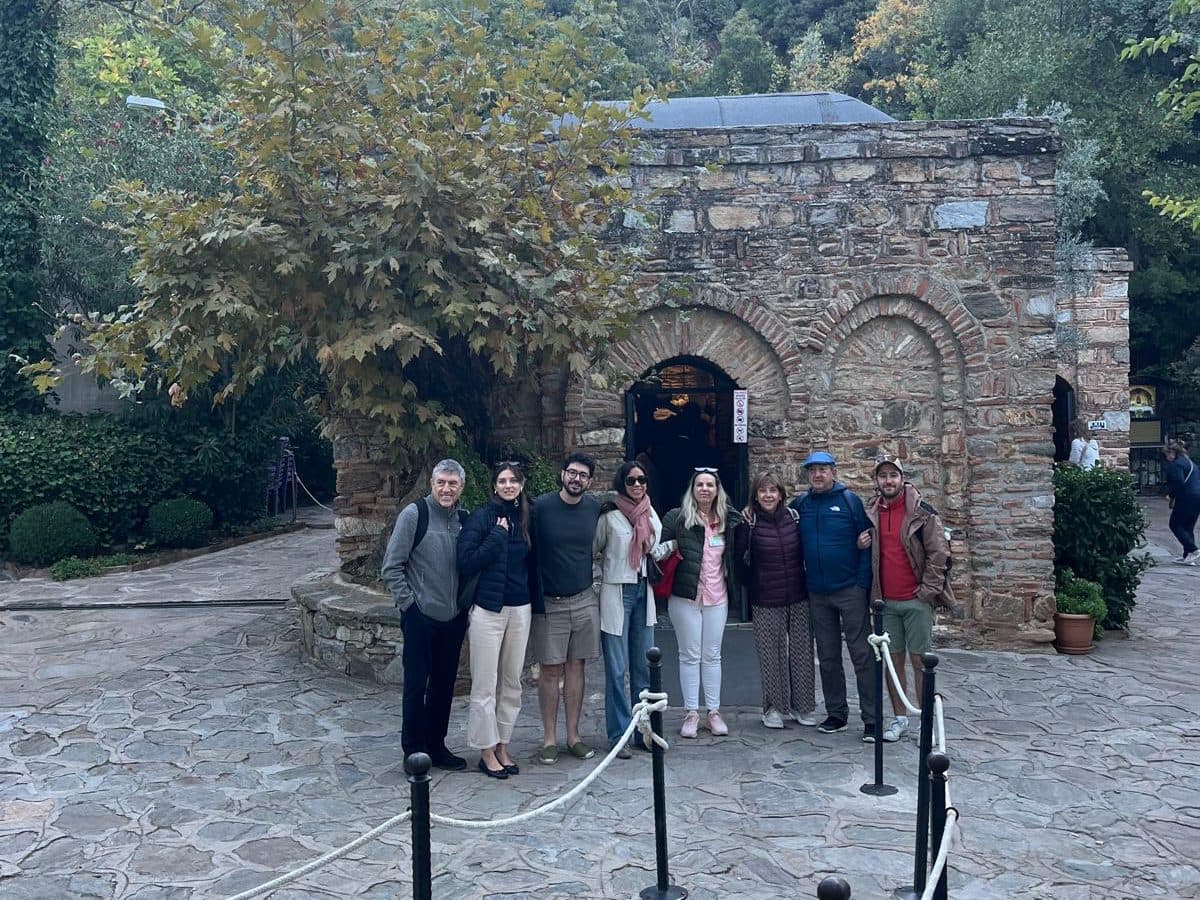
The House of the Virgin Mary is a small stone chapel on the eastern slope of Mount Koressos, about nine kilometres by road above the Ephesus archaeological site and twenty-five kilometres, roughly thirty-five minutes, from the Kuşadası cruise berth. According to a tradition confirmed in the nineteenth century by the visions of the German nun Anne Catherine Emmerich, Mary travelled here with the apostle John after the crucifixion and lived her last years on this hillside. For tickets, hours, dress and the road up in full detail, our visiting guide is the deepest resource we know how to write; this page is the shorter portrait.
A discovery that followed a book
The site was rediscovered in 1881 by a French priest who had never been to Türkiye before. He followed Emmerich's written descriptions, dictated decades earlier by a bedridden nun who had also never travelled here, and they led him to within fifty metres of the foundations. Excavation found a first-century house on exactly the indicated spot. The Catholic Church has never formally pronounced on the location's authenticity, and it does not need to for the place to work on you: it has recognised the site as worthy of pilgrimage, and four popes have prayed here, Paul VI in 1967, John Paul II in 1979, Benedict XVI in 2006 and Francis in 2014.
What a visit is actually like
The chapel is small, dim and stone-quiet, a single room and a side chamber, with the bronze statue of Mary in a niche above a simple altar and one candle burning. Most guests are inside for ten minutes and remember it for years; the film at the top of this page is our own photograph of that altar, set gently in motion. Mass is celebrated each morning, and attending the Sunday Mass carries free entry, a detail the crowds never seem to know.
Below the chapel, spring water runs from wall fountains that pilgrims queue to touch and bottle; the healing tradition attached to the water is old, local and entirely optional. Beside the fountains stretches the wish wall, tens of thousands of ribbons, tissues and scraps of paper tied by visitors of every faith, each one a request. Our guides have watched guests arrive curious and leave quiet at that wall more often than anywhere else on the route.
A shrine three faiths visit
What surprises many visitors is who else is here. Mary is deeply revered in Islam, an entire chapter of the Quran carries her name, and the panels by the chapel have displayed its verses since 1985. On a normal morning the queue holds Catholic pilgrims, Orthodox families, Muslim visitors and the merely curious, all moving through the same small door. There are not many places in the world where that sentence is simply a description.
Practicalities from the port
Entry is 700 TL in 2026, roughly 15 dollars or 13 euros, free if you attend the Sunday Mass. Summer hours run 08:00 to 18:00, winter 08:00 to 17:00. There is no public transport up the mountain, no dolmuş and no bus; the road is a winding forest climb, which is exactly why the site stays calm. The walk from the car park to the chapel is paved and gently graded, comfortable for every mobility level. As a stop it pairs naturally with Ephesus itself, nine kilometres below by road from the Upper Gate, and takes about fifty minutes on the ground at an unhurried pace.
Written by the Tours of Ephesus operations team, who bring guests here several times a week in season. No content lifted from third-party sources.