
The walking route, decoded
The Ephesus map, and the one route that makes the day downhill all the way.
Ephesus is a straight line, not a loop, and it drops about 70 metres from top to bottom. Enter at the Upper Gate, walk down to the Lower Gate, and gravity does the work. Here is the whole city in walking order: our own map, every monument worth your minutes, and honest itineraries for the hours your ship gives you.
The Library of Celsus at first light, before the gates open. An ambient film rendered from our own photograph.
In one paragraph
Ephesus is walked from the Upper Gate at the top down to the Lower Gate at the harbour, roughly 1.5 km and 70 metres of descent, never a climb. The unmissable stops are the Library of Celsus, the Great Theatre, the Temple of Hadrian and Curetes Street. Honest time on site is two to three hours, and the site opens at 08:00, which is the moment to be there.
By the Tours of Ephesus operations team · Last reviewed July 2026
The map
Ephesus, top to bottom, in ten stops.
- 1Upper Gate
- 2State Agora & Odeion
- 3Hercules Gate
- 4Curetes Street
- 5Temple of Hadrian
- 6Terrace Houses
- 7Library of Celsus
- 8Great Theatre
- 9Harbour Street
- 10Lower Gate
Rather listen?
A local guide walks you through it, in under six minutes.
The same plan, spoken by one of our licensed guides, for the drive out to the site or the deck chair before you dock.
A Local Plan for Visiting Ephesus
A five-minute orientation to Ephesus for anyone with a single day ashore at Kuşadası: what the city was, why it mattered, and how to spend your hours there.
Why the direction is the whole game
The single most important decision at Ephesus is which gate you start from. Enter at the Upper Gate and the marble carries you down past the council house, the fountains and the Hadrian temple to the Library of Celsus, then out along the level Harbour Street to the Lower Gate. Enter at the bottom and you finish with a climb up Curetes Street in the heat, which is the single biggest reason cruise guests reach their ships exhausted.
We have walked it both ways across twenty-five seasons. Upper Gate down is the answer every time. On a private tour the vehicle drops you at the top and waits at the bottom, so the walk is one-way and there is no doubling back.
About 1.5 km
The main paved route, Upper Gate to Lower Gate. Roughly 30 minutes of pure walking, two to three hours with the monuments.
One way, not a loop
Ephesus is a line. Start at the top, finish at the harbour. A private vehicle meets you at the Lower Gate.
No shade, hot marble
By 11:00 in summer the marble passes 50°C. The early start is not a luxury, it is the plan.
Opens 08:00
The first ninety minutes are cooler and the Library is walkable before the coaches arrive around 10:00.
By the hour
What to see in the time you have.
2 hours
The spine of the city
Enter at 08:00 and keep moving downhill to reach the Library before the coach groups.
Leave out · Leave the Terrace Houses, which need a separate ticket and 30 minutes, and do not linger at the State Agora.
3 hours
The honest full walk
The realistic visit: unhurried, with time to read the stones and photograph the Library properly.
Leave out · Skip the Terrace Houses unless you are genuinely keen, since everything else here fits without hurrying.
4 hours
The walk plus the Terrace Houses
Adds the Terrace Houses mosaics and frescoes on their raised walkway above Curetes Street, on a separate ticket.
Leave out · Little to leave out at this budget; just do not try to walk back uphill to the Upper Gate.
Full day
Ephesus plus the sites around it
Pairs the full downhill walk with the museum, the last Wonder of the Ancient World, and the Virgin Mary shrine.
Leave out · Nothing on the main route; if the clock tightens, drop a nearby add-on rather than rushing the ancient city.
These plans budget the hours inside Ephesus itself. For the whole day ashore, town and all, see what to do in Kuşadası on a port day, five itineraries planned hour by hour.
Every monument, in order
The whole city, stone by stone.
The Upper City
Civic Ephesus: council house, agora, imperial temples. Where the walk begins.
- 01Quick look
Upper Gate (Magnesia Gate)
The Magnesia Gate is the upper, southeastern entrance to Ephesus, set into the Hellenistic city wall raised under Lysimachus in the early 3rd century BC, where the road from Magnesia ad Maeandrum reached the city. For cruise groups it is simply the start of the walk: from here the route runs downhill, losing roughly 70 metres to the harbour. Little of the gate itself survives, so treat it as an orientation point rather than a monument.
5 min here
- 02Quick look
State Agora
The State Agora, or upper agora, was the civic and administrative square of Roman Ephesus, used for public business rather than trade, with a small temple once standing at its centre. It measures roughly 160 by 56 metres. Today it reads as a broad, largely bare field of foundations, so it rewards a glance more than a long halt.
8 min here
- 03Worth it
Odeion (Bouleuterion)
This roofed odeion doubled as the bouleuterion, the meeting chamber of the city council, and hosted concerts and recitals. It was given to the city around 150 AD by Publius Vedius Antoninus and his wife Flavia Papiane, and seated in the region of 1,400 people. Compact, well preserved and photogenic, it is an easy win early in the walk.
10 min here
- 04Quick look
Prytaneion
The Prytaneion was the town hall, home to the sacred eternal flame of Hestia that was never allowed to go out. It was here that excavators found the celebrated statues of Artemis of Ephesus now displayed in the Ephesus Museum at Selçuk. The columns are partly re-erected; the real treasures left long ago, so it is chiefly of interest for the story.
8 min here
- 05Quick look
Temple of Domitian
Dedicated around 89 to 90 AD, this was the first temple in Ephesus known to be given over to a Roman emperor, and the reason the city first won the coveted title of neokoros, or 'temple-warden'. What survives is mostly the great terrace and substructure rather than the temple above. Unless the politics of the imperial cult interest you, a brief look is plenty.
7 min here
- 06Quick look
Memmius Monument
A four-sided victory monument raised in the 1st century BC for Gaius Memmius, a grandson of the Roman dictator Sulla, whose forces retook Ephesus in 84 BC. Only a reconstructed corner of masonry stands today. It makes a decent photograph at the top of Curetes Street, but needs no more than a pause.
5 min here
- 07Quick look
Pollio Fountain
A monumental fountain on the edge of Domitian Square, associated with the family of Gaius Sextilius Pollio, the Augustan-era benefactor also behind the city's aqueduct. Its tall broken arch is what remains. It is a quick look on the way to Hercules Gate rather than a stop in its own right.
4 min here
 08Quick look
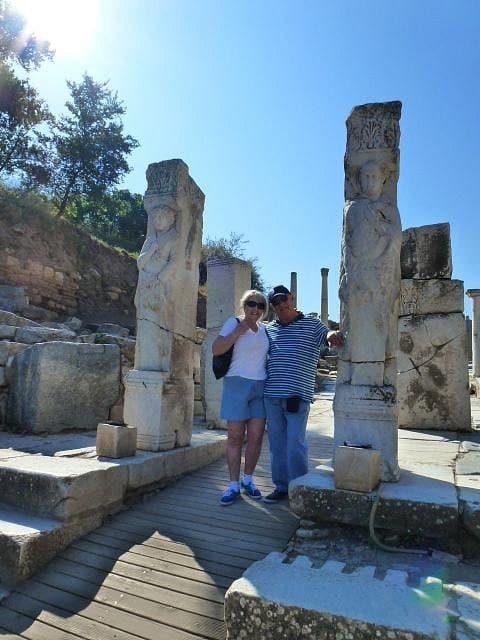
Hercules Gate
Two tall pillars carved with reliefs of Hercules wrapped in the skin of the Nemean lion frame the top of Curetes Street. Assembled in its present form in the late Roman period, probably the 5th century AD from reused 2nd-century reliefs, its stairs and narrowed span closed the street to wheeled traffic. Worth a moment for the carving before you start down the hill.
5 min here
Curetes Street
The marble spine downhill, past fountains, the Hadrian temple, and the Terrace Houses.
 09Must see
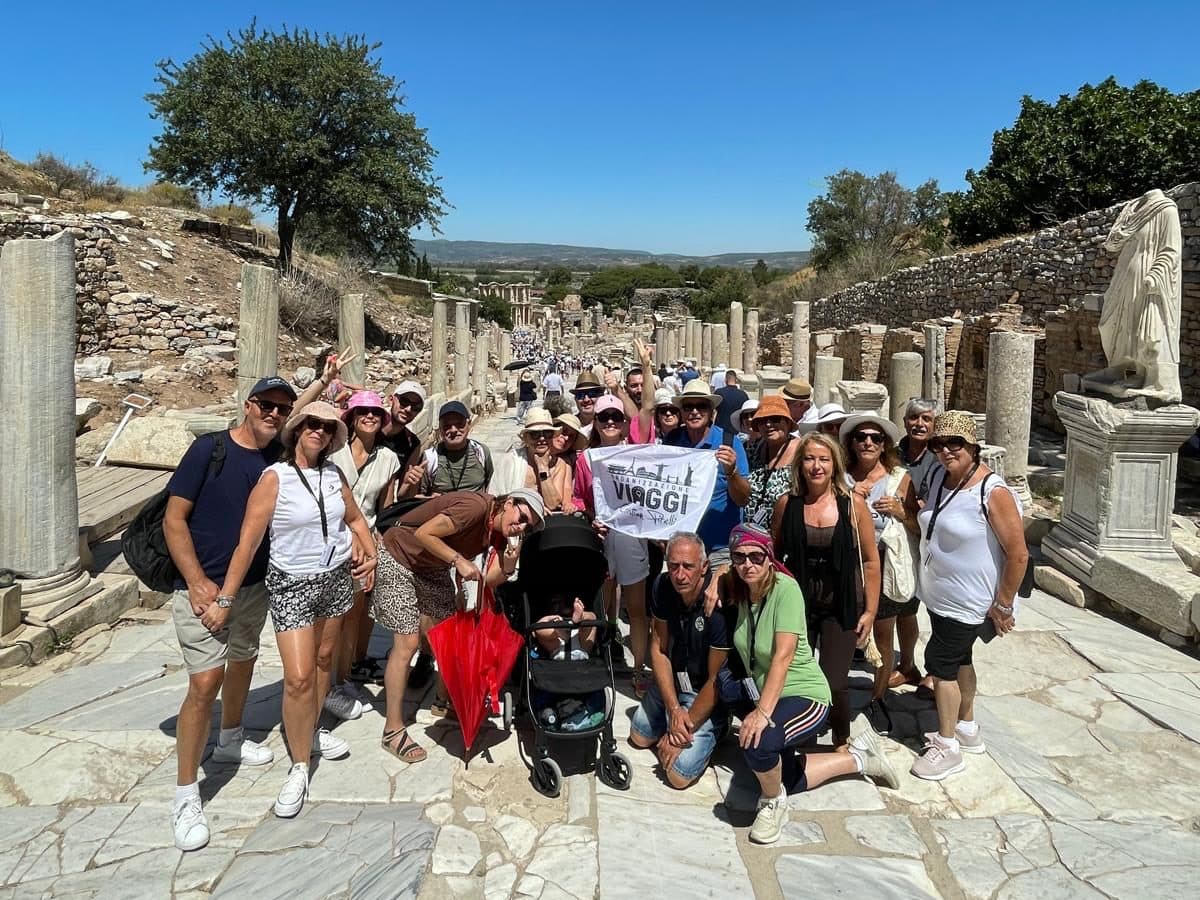
Curetes Street
Curetes Street is the marble-paved spine of the city, running downhill from Hercules Gate to the Library of Celsus and lined with fountains, monuments, shops and column bases. Badly shaken by earthquakes in the 3rd and 4th centuries AD, it was patched with columns salvaged from other buildings, which is why its colonnade is such a mismatched set. This is the walk itself, so you will spend real time here whether you plan to or not.
15 min here
- 10Worth it
Trajan's Fountain
A two-storey monumental fountain built between about 102 and 114 AD by the wealthy Ephesian Tiberius Claudius Aristion and dedicated to the emperor Trajan. A colossal statue of Trajan once stood over the water outlet with a globe beneath his foot; the surviving fragment of that globe and foot is still in place. Partly re-erected, it photographs well and rewards a short stop.
8 min here
- 11Must see
Temple of Hadrian
One of the most photographed monuments in Ephesus, this small, elegant temple front on Curetes Street was dedicated in the 2nd century AD to the emperor Hadrian, Artemis and the people of the city. The curved pediment carries a relief of the city goddess Tyche, and the inner doorway a figure usually read as Medusa among acanthus leaves. What you see is a careful reconstruction, and the finest relief panels are copies, with the originals in the Ephesus Museum.
10 min here
- 12Skip if short
Scholastica Baths
A large Roman bath complex behind the Temple of Hadrian, first built in the 1st or 2nd century AD and rebuilt in the late 4th century by a Christian woman named Scholastica, whose headless statue was found on site. The ruins are extensive but hard to read without a guide. For a guest short on time it is easy to leave out.
5 min here
 13Worth it
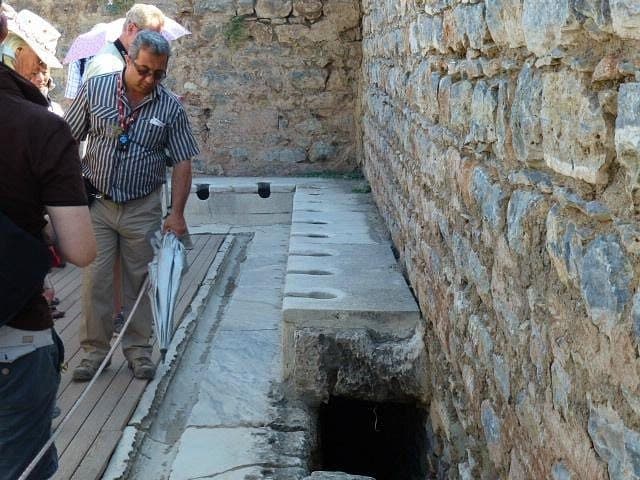
Public Latrines
The public latrines are one of the most popular quick stops on the site: rows of marble seats set over a running-water drainage channel, with a shallow pool in the centre of the room. They formed part of the Scholastica Baths complex and date to the Roman period. Small, memorable and quick, they are a reliable crowd-pleaser.
5 min here
- 14Worth it
Terrace Houses (Hillside Houses)
The Terrace Houses, or Hillside Houses, are a block of luxury Roman homes built into the slope opposite the Temple of Hadrian, lived in from the 1st to the 7th century AD. They hold the largest collection of Roman wall paintings and mosaics in this part of Turkey, now sheltered under a modern roof. They need a separate ticket and around half an hour, but for anyone interested in daily life they are the best-preserved thing on the site.
30 min here
The Library & Marble Street
The Celsus facade, the market gate, and the cart-rutted road to the theatre.
 15Must see
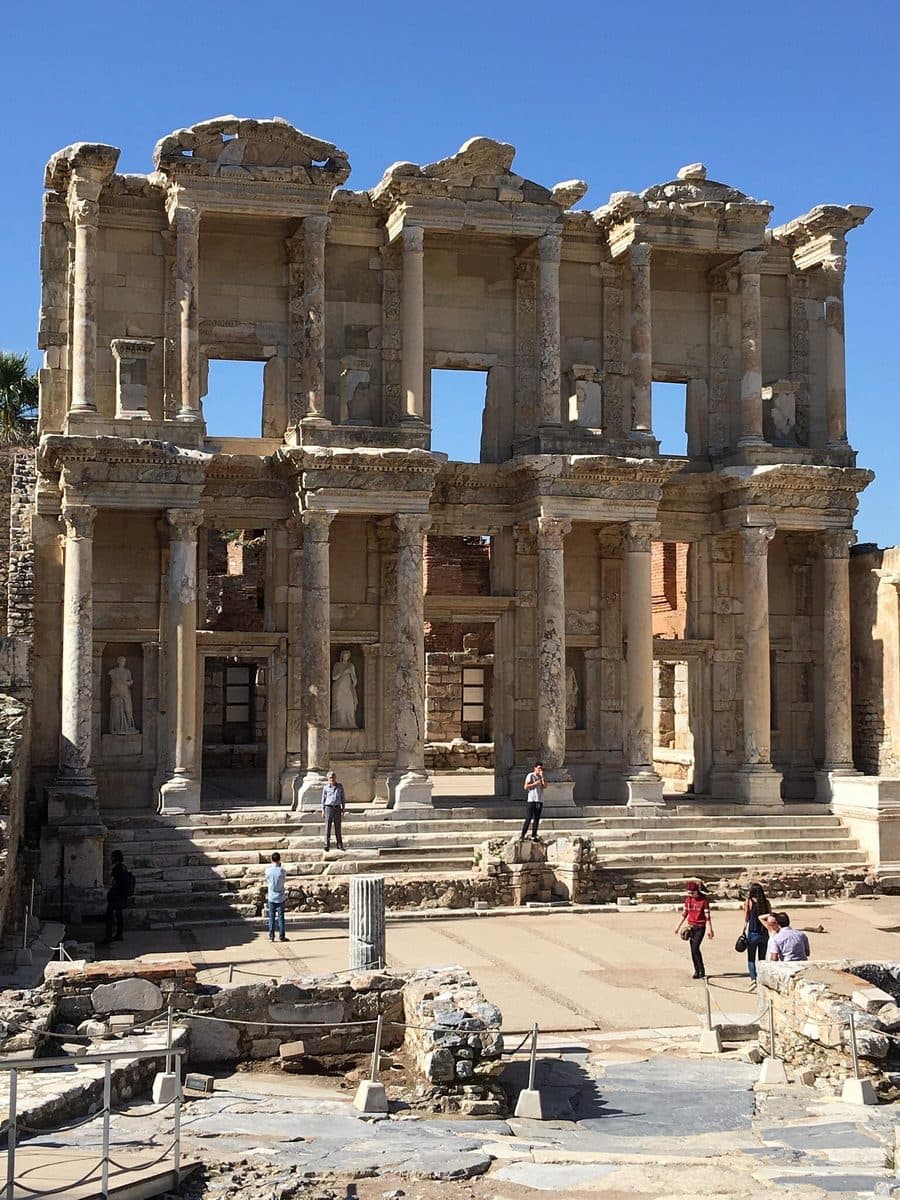
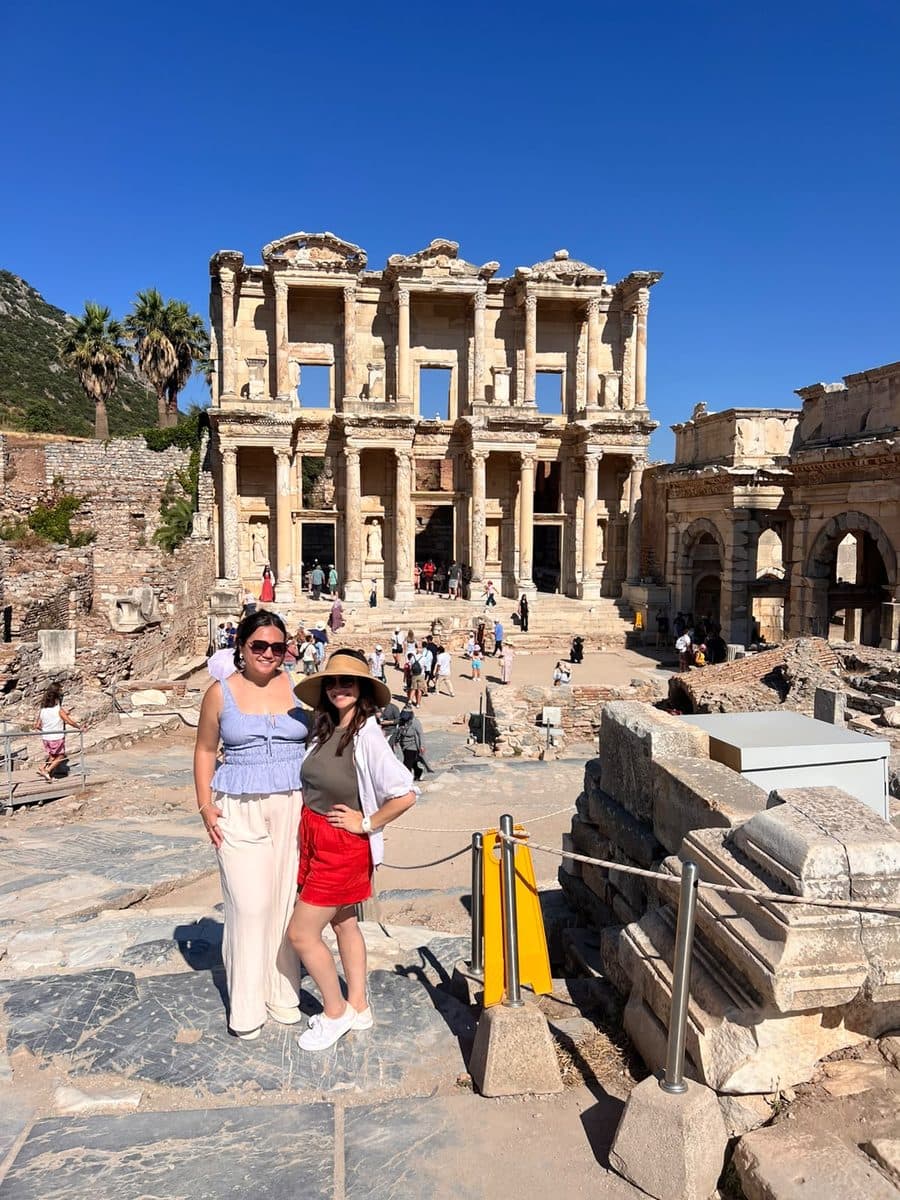
Library of Celsus
The Library of Celsus is the emblem of Ephesus: a two-storey marble facade completed in the early 2nd century AD by Tiberius Julius Aquila as a monument and tomb for his father, the Roman senator Celsus, whose sarcophagus lies in a vault beneath. It was built to hold in the order of 12,000 scrolls, kept in wall niches with a double wall behind them to guard against damp. The facade you see was re-erected from original blocks in the 1970s; expect crowds and plan your photograph.
15 min here
 16Quick look
Gate of Mazeus and Mithridates
This triple-arched gate beside the library was built around 3 BC by two freedmen, Mazeus and Mithridates, and dedicated to their former masters, the emperor Augustus and his family. Its inscriptions were once picked out in bronze lettering. It leads from the library courtyard into the Commercial Agora and takes only a moment.
4 min here
- 17Quick look
Marble Street
Marble Street runs from the library gate towards the Great Theatre, paved in slabs still scored with the ruts of ancient carts. A much-repeated carving in the paving is often pointed out as an advertisement for the brothel, a claim to take with some salt. You walk its length regardless, so treat it as part of the journey.
8 min here
- 18Quick look
Commercial Agora (Tetragonos Agora)
The Commercial Agora, ancient name Tetragonos or 'square market', was the city's main marketplace: a colonnaded square roughly 110 metres on each side with shops and workshops behind the porticoes. Set back below Marble Street, it is often quieter and largely reduced to foundations and column stumps. Fine to view from the edge if you are pressed.
6 min here
The Theatre & Harbour
The 24,000-seat theatre and the lamp-lit avenue out to the Lower Gate.
 19Must see
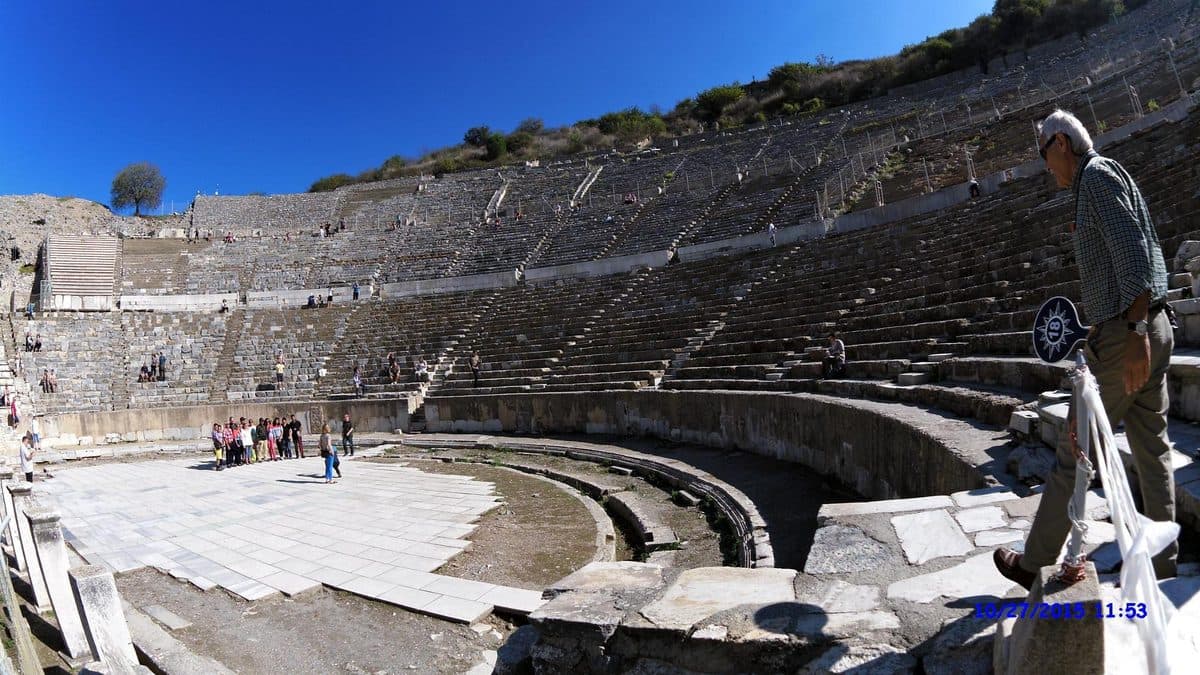
Great Theatre
The Great Theatre is the largest surviving monument on the site, cut into the slope of Mount Pion and enlarged to its present scale by the Romans in the 1st and 2nd centuries AD. It held in the region of 24,000 spectators, making it the largest theatre in Asia Minor, and it is traditionally the setting for the riot of the silversmiths against Saint Paul described in Acts 19. You will want time to climb a few rows and look back down Harbour Street.
15 min here
- 20Worth it
Harbour Street (Arcadian Way)
Harbour Street, the Arcadiane, is the grand colonnaded avenue running from the theatre towards the now silted-up harbour, over 500 metres long and around 11 metres wide. Restored under the emperor Arcadius around 400 AD, it was one of very few streets in the Roman world lit at night, by an inscribed total of fifty lamps. It makes a fitting, level finish to the walk before the Lower Gate.
10 min here
Before you go
The practical facts.
Entry
40 euros for foreign visitors in 2026. The Terrace Houses inside carry a separate ticket. On our tours the arrangements are handled, so no ticket queue: what that does and does not mean at the gate.
Hours
The site opens at 08:00 and closes at 19:00. The Upper Gate ticket window shuts at 18:00, an hour before the Lower Gate one. Be at the Upper Gate for opening; by mid-morning the Library and the heat arrive together.
Getting there
About 20 km and 20-25 minutes from the Kuşadası cruise port, through Selçuk, no toll.
Toilets
Modern toilets sit just outside both gates. There are none inside, a 1.5 to 2 hour stretch, so go before you enter.
What to bring
Sun protection and water in the warm months, a layer in the cool ones, and shoes with grip. The marble is beautiful and slick.
Time needed
Two to three hours on site at an honest pace, plus 30 to 45 minutes if you enter the Terrace Houses.
Mobility, honestly
Is Ephesus walkable for slower legs?
Honestly, much of Ephesus is uneven ancient marble, stone paving and slopes, with no smooth path along Curetes Street. The one real advantage is direction: entering at the Upper Gate means the whole route runs downhill, which is far kinder on knees and stamina. A wheelchair or walker needs a strong helper, and the Terrace Houses stairs are not manageable for everyone.
What a private day gives a slower walker is control: we drop you at the top, keep the vehicle at the bottom, plan rest points in the shade, and shorten the route to the stops that matter most. We would always rather set expectations before you book than have you discover the marble the hard way. Tell us your situation and we will tell you honestly whether the day works.
Map & planning FAQ
The questions people actually ask.
Walk it with a local
We will map your day around your ship.
Tell us your hours in port and we will plan the route: dropped at the Upper Gate, collected at the Lower, a licensed guide, and no payment until you are back on board.