
Visiting guide · tickets, hours, getting there
The House of the Virgin Mary, visited properly
A small stone chapel on a pine-covered mountain above Ephesus, held by tradition to be where Mary lived her last years. Here is everything a visit actually requires: the 2026 ticket, the road up, the walk itself, and the quiet hours.
- 420 mMount Koressos elevation
- 25 km35 min from Kuşadası port
- 45-60 minA typical unhurried visit
House of the Virgin Mary, in one paragraph
The House of the Virgin Mary (Meryem Ana Evi) is a stone chapel at 420 metres on Mount Koressos above Ephesus, 25 kilometres from Kuşadası cruise port. The entrance fee is 700 TL in 2026, about 15 US dollars, and the site is open 08:00 to 18:00 in summer. No public transport climbs the mountain road; visitors come by tour or hired car, and most pair the chapel with Ephesus in a single morning.
- Written by
- Tours of Ephesus operations team
- Last reviewed
- July 2026
Fee and road facts confirmed by our own guides who drive this mountain most mornings of the season. No content lifted from third-party sources.
Plan the visit
The three things to know before you go.
Tickets (2026)
700 TL per person, about 15 USD or 13 EUR
Paid at the gate; guests arriving for Sunday Mass enter free. On our tours the guide pre-purchases every ticket, so you walk past the booth.
Hours
08:00 to 18:00 in summer, 08:00 to 17:00 in winter
Mass is celebrated at the chapel; for the current liturgy calendar, check the official shrine site below.
Getting there
By vehicle: 25 km, about 35 minutes from Kuşadası port
No bus, no dolmuş, no shuttle climbs the mountain road. Tour vehicle or a taxi hired for the round trip.
Pay after your tour
The chapel pairs naturally with Ephesus in one private morning.
Planning the rest of the day? See what to do in Kuşadası on a port day, planned hour by hour.
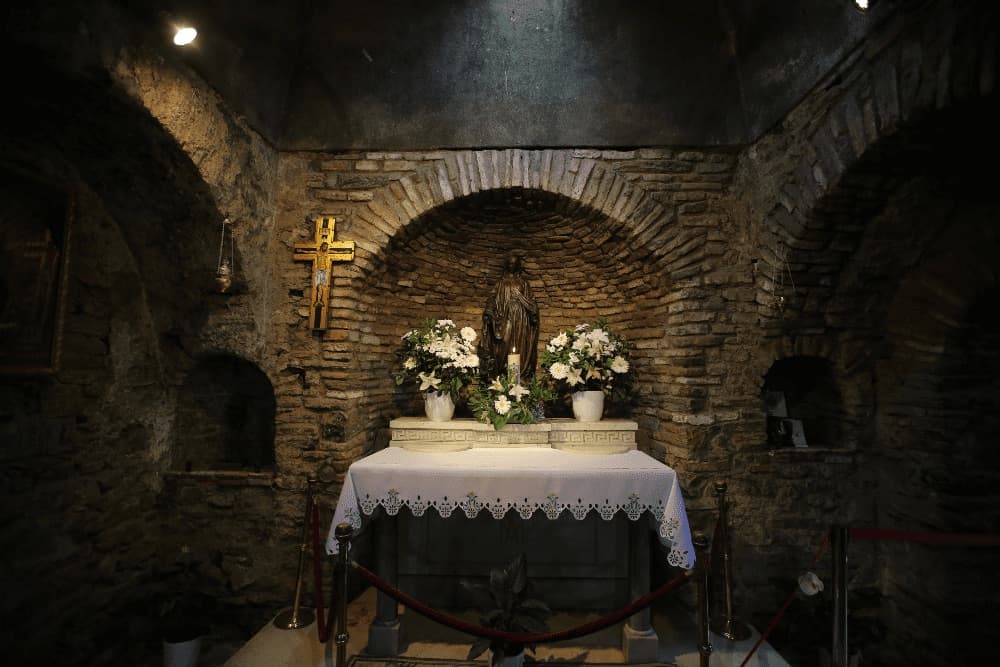
Inside the chapel
A room the size of a village kitchen, and a silence that fills it.
The story, told straight
A nun who never travelled, and a house that was there.
Tradition holds that after the crucifixion, the apostle John brought Mary to Ephesus, the city entrusted to him, and that she lived her last years on the mountain above it. For centuries that was a story without an address.
The address came from an unlikely source: Anne Catherine Emmerich, a bedridden German nun who never left her region, described the house and its hillside in detail in her recorded visions. In 1881 a French priest followed those descriptions up Mount Koressos and found ruined foundations within fifty metres of where she placed them. Excavation dated the lowest walls to the first century.
Here is the honest part, the same thing our guides say at the door: none of this proves Mary lived here, and the Catholic Church has never pronounced on the question. What the Church did do is recognise the site as worthy of pilgrimage in 1896, and then send four popes up the mountain in person.
Stand in the chapel for five minutes and the authenticity debate quietly loses its grip. Whatever this room is, a century and a half of prayer has made it something. The papal visit records live in the Vatican's own archive, Benedict XVI's 2006 Ephesus Mass among them.
Recognition
Four popes up one mountain road.
- 1881
The house is found
A French priest follows Anne Catherine Emmerich’s written visions up Mount Koressos and locates first-century foundations where she described them.
- 1896
The Church responds
The Catholic Church recognises the site as worthy of pilgrimage, without ruling on authenticity. Pilgrimages begin.
- 1967
Paul VI
The first reigning pope to visit the house, praying in the chapel itself.
- 1979
John Paul II
Celebrates at the shrine early in his papacy and confirms its place on the pilgrim map.
- 2006
Benedict XVI
Celebrates an open-air Mass on the hillside during his Türkiye visit.
- 2014
Francis
The fourth papal visit in under fifty years. Few sites anywhere match that cadence.
What you will actually see
Four stops, forty-five minutes.
- 01
The approach
From the car park a paved, gently graded path leads in under cypress and pine. The mountain air is noticeably cooler than the ruins below, one reason mornings here feel unhurried.
- 02
The chapel
The house itself, rebuilt over first-century foundations, is a small dim room with an altar and the statue of Mary. On the wall hangs a portrait of Mary painted in 1978 by Rastislas Loukine, a Russian-born French painter, after his own visit. Conversation drops to a whisper without anyone asking.
- 03
The sacred spring
Below the chapel, taps carry water from the spring under the house. Pilgrims fill small bottles; guests of every faith queue together. Bring a small empty bottle if you want to take some home.
- 04
The wish wall
A long wall where visitors tie ribbons, tissues, and written petitions, tens of thousands of them, in every language. Candle stands wait nearby for guests who prefer a flame to a knot. The most photographed square metres on the mountain, and somehow still personal.
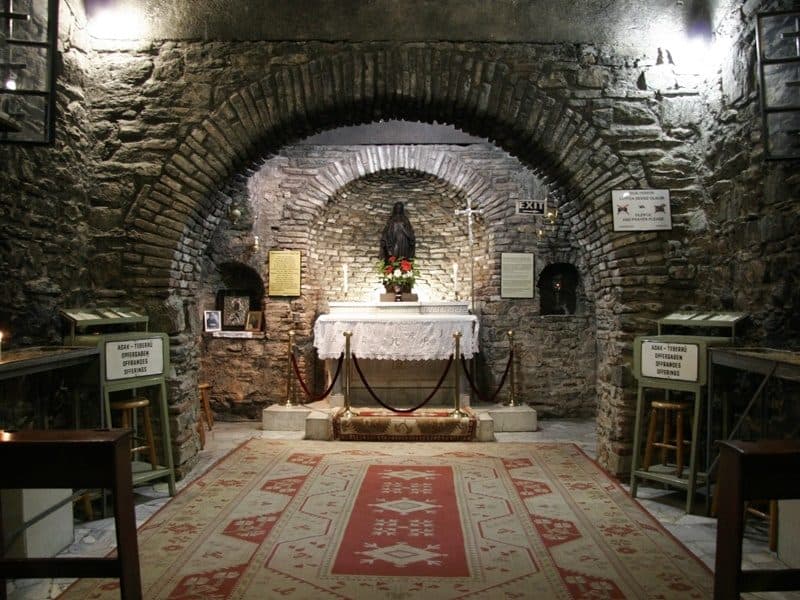
Inside the chapel: the altar and the niche, a room the size of a village kitchen. 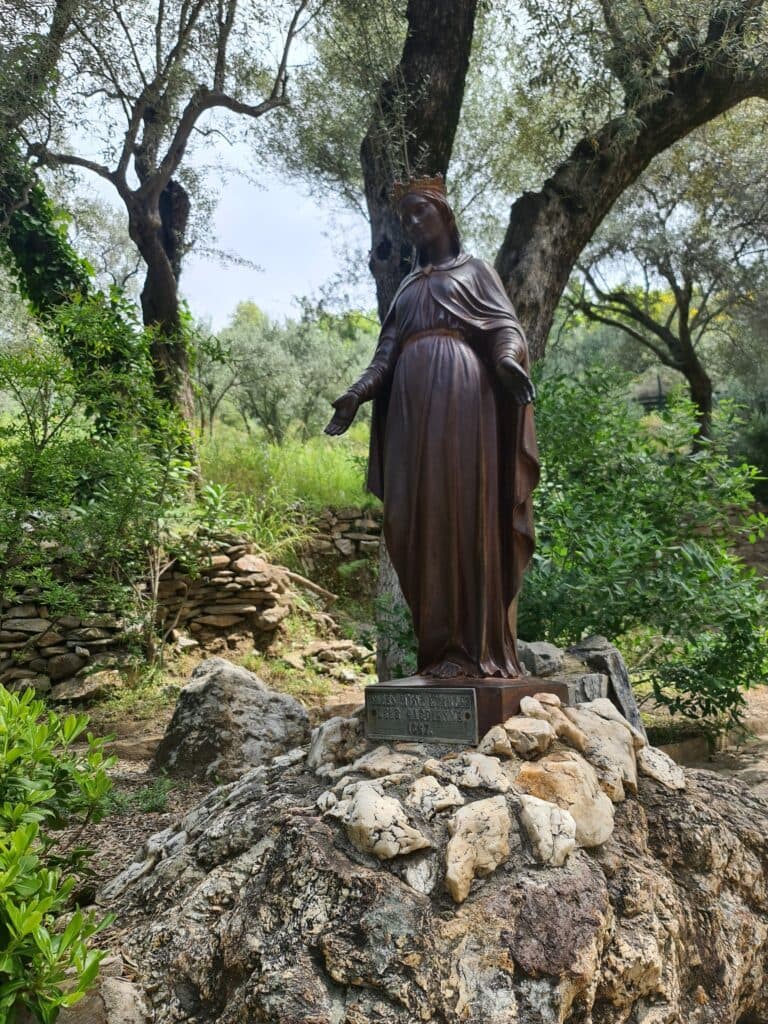
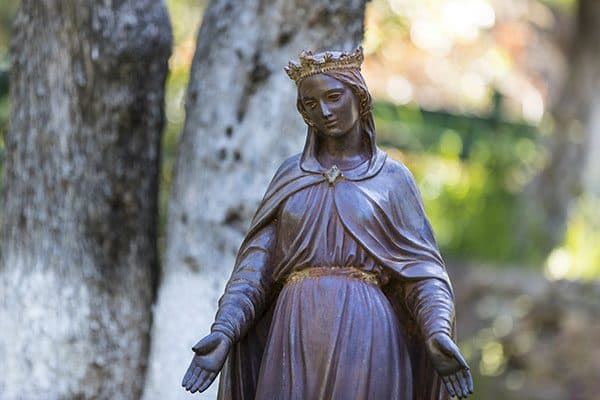
Mary among the olives, on the path below the house. 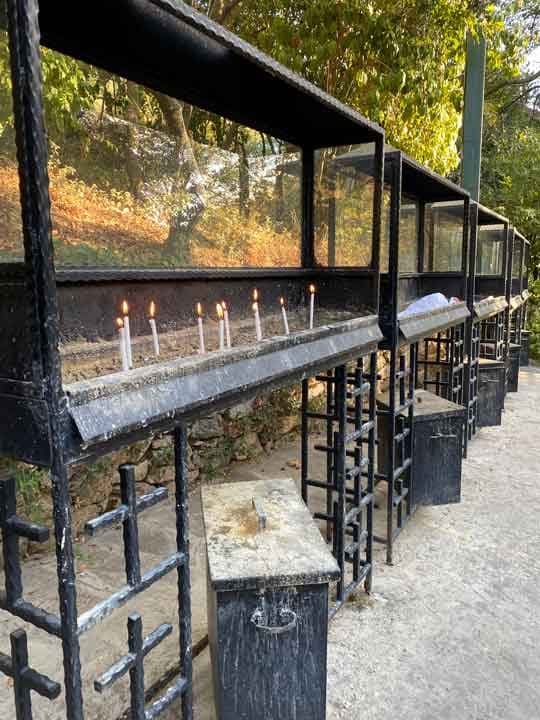
Candles behind glass: the second way visitors leave a wish. 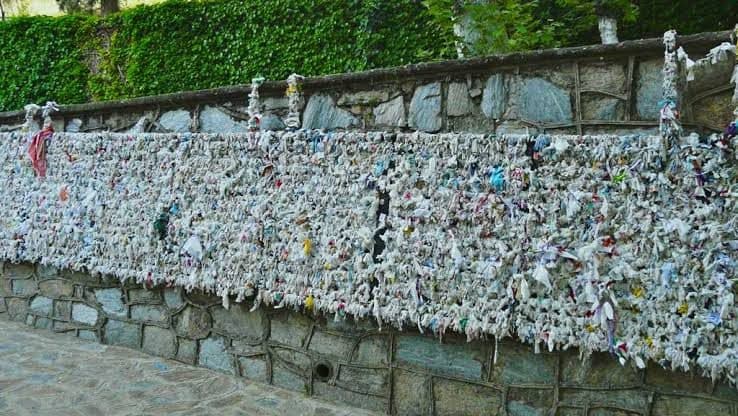
The wish wall: tens of thousands of knots, every language represented.
Getting there
One road up, and it is yours to arrange.
The drive, measured
Google Maps driving route- Kuşadası port to Ephesus Upper Gate
- The valley leg, shared with every Ephesus visit.
- 20 km20-25 min drive
- Kuşadası port to the House of the Virgin Mary
- The valley road, then the switchback climb up Mount Koressos.
- 25 km35 min drive
- Ephesus Upper Gate to the shrine
- The short hop most combination tours make first thing; the forest footpath climbs the same flank.
- 9 kmswitchback drive
- Ephesus Lower Gate to the shrine
- The longer way round, the route a taxi takes if it picked you up at the bottom of the site.
- 12 kmvia the Selçuk side
Taking a taxi anyway? Agree one total price at the port, run plus mountain waiting time, before you ride; there is no taxi rank waiting at the shrine. Coming overland instead, İzmir Airport is about 70 km away, signposted from Selçuk. And for strong walkers a forest footpath climbs from the Ephesus Upper Gate to the shrine in about an hour.
When to go
The mountain rewards the early.
Go first thing
The chapel is quietest right after opening, before the coach wave arrives from the port. Early on the mountain also means cypress shade and cool air; by late morning the queue for the chapel door stretches into the sun.
Shrine first, ruins second
Our standard route climbs to the House of the Virgin Mary first, then descends to the Ephesus Upper Gate. The geography does the work: you start at 420 metres and the whole day flows downhill from there.
Attending Mass
Mass is celebrated at the chapel, and pilgrims are welcome. If attending matters to you, tell us when you book and check the calendar on the official shrine site; we build the morning around it.
Etiquette and practicalities
A shrine first, a sight second.
What to wear
There is no dress code here, and none at Ephesus either. Wear whatever you are comfortable walking in; the paths on this site are short and paved.
Inside the chapel
Keep conversation low; this is an active place of worship, not a museum room. Guides give their commentary outside and let the room speak for itself.
The ticket
700 TL per person in 2026, roughly 15 USD or 13 EUR, paid at the gate. On our tours it is pre-purchased by the guide along with every other entrance.
The spring water
Filling a small bottle at the taps is an old custom and freely allowed. Bring your own bottle; the site is a shrine, not a shop line.
The ribbon custom
Tying a ribbon or written petition at the wish wall is open to visitors of every faith. Paper and cloth weather away naturally; plastic does not, so choose accordingly.
Mobility
The path from the car park is paved and gently graded, one of the easiest sites in the region for wheels and slow walkers. The chapel itself is step-free at the main entrance.
Who the visit is for
Four kinds of guests, four different visits.
Catholic and Orthodox pilgrims
This is the emotional summit of the coast: a recognised pilgrimage site with Mass at the chapel and four papal visits behind it. Pilgrims often tell us the visit, not Ephesus, was the reason they chose the port.
Protestant and Bible-focused guests
The draw is the geography of the New Testament: John’s Ephesus, the church addressed in Revelation, and the city where the Council of 431 proclaimed Mary Theotokos. Our biblical itinerary reads the sites in that key.
Muslim visitors
Mary (Meryem) is deeply honoured in Islam, and the shrine acknowledges it: by the exit, panels placed in 1985 at the İzmir Governor’s request display the Quranic verses about her in Turkish and French. Many Turkish families visit, especially on summer weekends.
Guests who are not religious
An honest word: this is a serene hilltop with cypress shade, a fine view, and a moving folk ritual at the wish wall. If that does not sound like your hour, we say so and give the time to Ephesus instead. We never push the shrine on anyone.
Asked before every visit
Virgin Mary house questions, answered straight.
Entrance is 700 Turkish lira per person in 2026, roughly 15 US dollars or 13 euros, paid at the gate. Guests arriving to attend Sunday Mass enter free. On our tours the guide pre-purchases every entrance ticket, including this one, so the fee is already inside the tour price.
The shrine is open 08:00 to 18:00 in the summer season and 08:00 to 17:00 in winter. For the Mass calendar and any special closures, meryemana.info, the sanctuary’s official site, carries the current schedule. On a cruise call, any morning tour lands comfortably inside the open hours.
By vehicle: it is 25 km from the cruise port, about a 35-minute drive, the last stretch on a mountain road of switchbacks. From the Ephesus Upper Gate the shrine is 9 km; from the Lower Gate, about 12 km via the Selçuk side. There is no bus, dolmuş, or shuttle to the shrine. Visitors come on a tour or in a taxi hired for the round trip with waiting time agreed up front.
No, none at all. The dolmuş network ends near the Ephesus Lower Gate in the valley below; nothing public climbs Mount Koressos. Strong walkers can take the forest footpath from the Ephesus Upper Gate, about an hour uphill, but on a port day the clock rarely allows it. This is the single most common planning mistake we see guests make with the shrine.
Yes, and it is the classic route: the shrine first thing while it is quiet, then down to the Ephesus Upper Gate for the downhill walk through the city. Our private combination tour does exactly this in about four hours door to door, timed to your ship.
It cannot be proven historically, and we tell guests so. The location matched the recorded visions of Anne Catherine Emmerich, a German nun who never travelled here, and excavation found first-century foundations on the spot. The Catholic Church has never ruled on authenticity but recognised the site for pilgrimage in 1896, and four popes have visited in person.
No. There is no dress code at Ephesus, the Temple of Artemis, the House of the Virgin Mary or the Basilica of St John. Wear whatever you are comfortable walking in. The one thing that matters is footwear: Ephesus is a downhill walk on ancient marble, so flat, closed, comfortable shoes make more difference than anything else you pack. At the House of the Virgin Mary itself the paths are short and paved, so footwear matters less there than at Ephesus.
Forty-five minutes to an hour covers the chapel, the sacred spring, and the wish wall without hurrying. The site is compact; what takes time is the stillness, and it deserves it.
Yes, Mass is celebrated at the chapel and pilgrims are welcome to join. Check the current liturgy calendar on the sanctuary’s official site, and tell us when you book; we shape the morning so you are at the chapel at the right hour.
Largely yes, and better than almost any ancient site nearby: the path from the car park is paved and gently graded, and the chapel entrance is step-free. Tell us about your party and we plan gate-to-gate accordingly.
Honestly: sometimes. It is a serene hilltop with real atmosphere, and the wish wall moves people who expected nothing. But if your port hours are short and faith is not part of the draw, we usually suggest giving the whole morning to Ephesus, and we say so plainly when asked.
A spring rises beneath the house and its water is piped to taps below the chapel. Pilgrims traditionally fill small bottles to take home; the custom is open to everyone and there is no charge. Nearby stands an old stone well that some visitors hold to carry healing and fertility blessings; belief rather than doctrine, but a queue forms all the same. Bring your own small bottle.
10 · You might also like
Ephesus tours from Kuşadası cruise port
Mount Koressos · 420 m
Some places you visit. This one you stand still in.
Tell us your ship and date. We put the chapel first on the morning, tickets in hand, and the rest of the day flows downhill to Ephesus.